

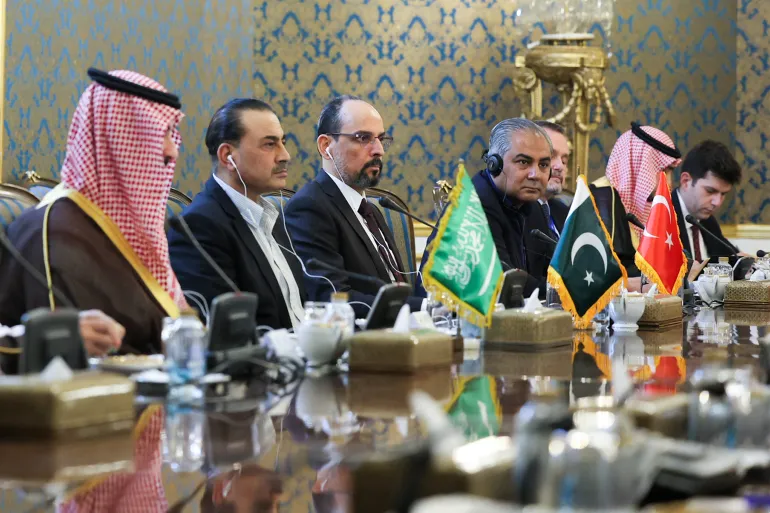
As the Houthi threat grows in the Middle East, Saudi Arabia, Turkey, Pakistan and Iran came together on Monday for an agreement to prevent a regional crisis.
This is the first high-level contact meeting between Iran and the parties to the Mecca Pact since the escalated Houthi attacks.
“The countries have agreed to continue talks to restore peace in West Asia,” Iranian state television said.
“Building a regional nonaggression network was a major point of discussion,” A senior Pakistani security official told Reuters.
And the negotiations between the US and Iran, Houthi attacks on Saudi Arabia, the Strait of Hormuz and the US blockade of Iranian ports were also discussed, the official added.
“Agreed to continue the dialogue to strengthen cooperation amongst the four regional countries, including for peace and security in the region”, Iranian state-owned TV said.
“The visit underscores the crucial role of Mecca Joint Defence Agreement countries in reinforcing regional security and stability and working with all in the region to achieve that goal,” Rayed Krimly, the Saudi deputy minister for public diplomacy, wrote on X.
“As talks continue, the Mecca Joint Defence Agreement signatories will most likely minimise the impact on Saudi Arabia if the regional instability escalates,” Analysts say.
The meeting was attended by Saudi Defence Minister Khalid bin Salman Al Saud, Pakistan’s army chief Asim Munir and Turkish intelligence chief Ibrahim Kalin.
Mohsen Rezaei, secretary of Iran’s Supreme National Security Council, hosted this meeting, and Iranian President Masoud Pezeshkian was also present.
After multiple attacks on Saudi Arabia’s infrastructure, including its Holy city Mecca Oil facilities and Airports in the past few months.
On Tuesday, the Houthis took responsibility for the attacks at the Abha International Airport and the Saudi Ministry.
Tension between Washington and Tehran has risen as Donald Trump stated on Friday that the US may strike Iran again, and IRGC officials announced plans to attack undersea cables if they are provoked.
The recent attacks have cause restriction of shipping energy through the Bab-el-Mandeb, increased global oil and gas prices, left the Gulf states facing missile and drone attacks.
It also caused the civil war in Yemen between the government and Houthi rebels, which has toppled regional security and stability in West Asia.
