

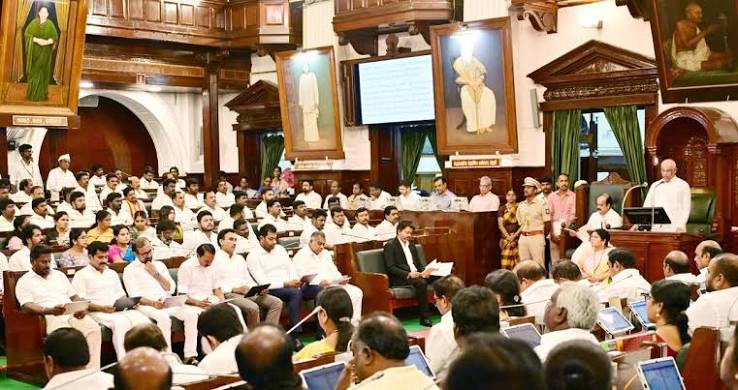
The Legislative Assembly of Tamil Nadu has once again raised a 20-year-old demand for the Centre to designate Tamil as the principal language of the Madras High Court.
The resolution has been moved by Chief Minister C. Joseph Vijay and unanimously passed on Thursday.
According to Vijay, rapid advancements in translation technology, particularly AI-powered ones, have handled the challenges that could otherwise make implementation difficult.
In the resolution, it has been sought that the Centre permit all petitions, documents, and oral arguments in Tamil. In addition, it requested to ensure that all judgments, decrees, and orders passed by the High Court be made available in the same language.
This is not all. The proposal demands training and translation facilities in Tamil for judges, lawyers, and court officials.
Vijay reminded members that Tamil already holds official status in the state under a 1956 law, and lower courts, tribunals and revenue courts under the High Court’s jurisdiction already record evidence and pass orders in Tamil.
He backed the resolution with two constitutional pegs: Article 348(2), which lets a state’s official language be used in High Court proceedings once the Governor and President sign off, and Section 7 of the Official Languages Act, 1963, which allows judgments and orders to be issued in a regional language alongside English.
This isn’t new ground for Tamil Nadu. The Assembly passed an almost identical resolution back in December 2006. That proposal eventually reached the Chief Justice of India’s office; the Centre informed the Rajya Sabha in 2018, but the Supreme Court had turned it down after deliberating in 2012.
According to the resolution, what has changed since then is the technology. The e-courts, legal database, and real-time translation have solved one major problem pointed out previously – that judges not from Tamil Nadu will not be able to understand the proceedings in Tamil.
At present, only four states conduct their High Courts in a language other than English and in all such cases, the language being used is Hindi. The states that fall into this category are Uttar Pradesh, Bihar, Madhya Pradesh, and Rajasthan. No high court in India has ever been allowed to work in a non-Hindi regional language.
Moreover, the Assembly has asked the Union Government to take action upon receiving a proposal from the Governor based on Article 348(2).
By this resolution, Tamil Nadu has made a request that has been pending for almost 20 years, hoping that this development reaches the state, which should have happened two decades ago. TPB
