

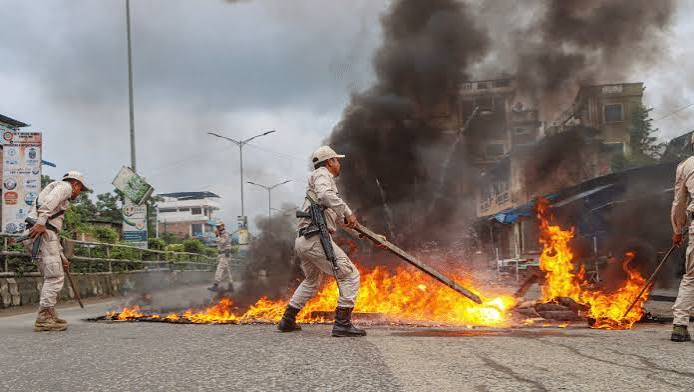
More than three years after ethnic violence uprooted thousands in Manipur, the delayed Census 2027 has raised a crucial question: how do you count a population that has been forced from its homes?
On 5th September 2026, the Centre put the Census 2027 in Manipur on hold until ‘further notice ’.
This was done by a Ministry of Home Affairs notification issued on 7th January.
Originally, house listing was to take place between 1st-30th September, with self-enumeration between 17th-31st August.
The Manipur High Court has intervened and ordered for the census to be put on hold until 30th April 2027.
It also ordered that the Registrar General and Census Commissioner look into 7 representations regarding the enumeration of displaced persons.
Following the outbreak of violence between the Meitei and Kuki-Zo communities on the 3rd May 2023, there are varied estimates of the number of displaced people.
Congress leader Okram Ibobi Singh said that over 50,000 people remain displaced.
Civil society groups led by AMUCO have said that nearly 60,000 people are in camps or elsewhere.
There are also differences in where displaced Meiteis from Kangpokpi and Churachandpur have gone to relief camps in the Imphal Valley in the Kuki area.
According to reports, in April displaced people from Ikou (Sajiwa Relief Camp) raised concerns about the census.
They said conducting the census now would cause inaccuracies, people being left out, and long-term issues with identity and rights.
Many of those protesting had been in camps for over 2 years and worried that families would be listed as living in the camps, instead of anywhere they intend to live.
Their original village may also be noted as having no one living there.
Why Displacement affects the Census
The census is based on the assumption that people live where they are listed but In Manipur, this is not the case.
Incorrect listings: Households may be listed in temporary accommodation. This causes large drops in villages of origin.
Missing people: People living with family members, in rented rooms or outside of the state may be missed.
Inaccessible areas: Due to security issues, some areas may not be accessible for enumeration.
The census is important as it helps allocate resources, draw constituencies and claim representation for communities.
In a state where numbers are already a political issue, it is important that the census is accurate.
Inaccuracies could cause more distrust, as some groups have also linked the census to demands such as identifying illegal immigrants (using 1951 as a base year).
Training for the census has reportedly been put on hold due to increased protests.
The last census in India was conducted in 2011; planning for health, education, housing and food security is based on outdated estimates.
As people have been displaced, this has caused issues with where they live, what school their children go to and how many depend on the camp food.
Without new data, the state cannot accurately determine where they need to provide services or who has lost land, jobs and documents.
The Manipur Congress argued that it is not possible to accurately collect data whilst communities are displaced.
Civil society leaders have said that due to thousands of people being displaced from nearly 3 years of violence, it is not the right time.
However, the state government have said that it is important to get the order right.
Chief Minister, Y Khemchand Singh, said the census will take time as the Special Intensive Revision of electoral rolls and house listing must come first.
What will happen
3 factors will determine whether the future census will be credible or not.
Are displaced persons going to be listed at their original location, current location or both, with clear indicators?
Can the enumeration be carried out safely and perceived as neutral by all communities?
Will the representations made to the High Court be looked into by the authorities in a transparent manner before the April 2027 deadline?
As seen in Manipur, there is a difficult balance: if the census is rushed, there is a risk of solidifying the inaccuracies caused by the conflict.
However, if it is put on hold indefinitely, then the policymakers will be in the dark.
This is likely less about the logistics of the census and more about whether displaced families feel safe and list their true location.
