

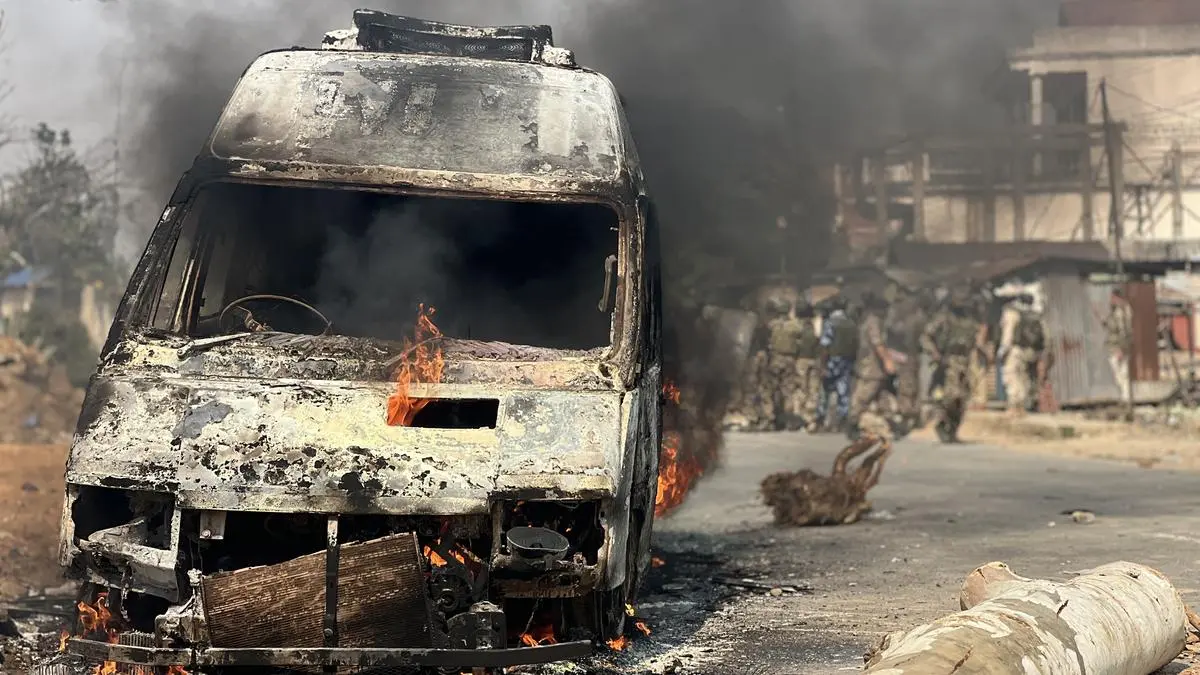
Three and a half years after the ethnic conflict in Manipur, farmers, mothers, students and volunteers have stories to tell.
Despite the official statistics, many stories lie behind the fear that exists in the jewel state of the Northeast.
In Chassad village of Kamjong district, at least 15 Kuki homes burned down, leaving families fleeing to the forest and a security camp.
Earlier this October, at least nine people were killed in Kamjong, Kangpokpi and Ukhrul in gunfights, ambushes and arson.
On the 19th of October, three villagers were shot dead whilst cutting down trees near Imphal.
Despite the constant change in victims, all communities, including Kuki, Naga and Meitei, were scared.
The conflict started between the Kuki and Meitei communities back in 2023.
Later, the conflict shifted to the hill districts between the Naga and Kuki communities.
According to Human Rights Watch, there have been 34 deaths in clashes between the two communities since February.
Over 48 civilians were reported to have been abducted by armed groups from both communities in Kangpokpi and Senapati.
Some are still in captivity, with civilians being used as pawns.
Around 43,000 displaced people are living in relief camps, and a child born in 2023 will now be walking and talking in the camp.
Education has suffered greatly, with government schools struggling to function and private institutions unable to take displaced children for free.
The government claim this is a difficult situation.
Yumnam Khemchand Singh became Chief Minister in February 2026 after a period of central government.
Security forces are constantly rushing to hotspots, and the NIA have made new arrests in the Trongloabi IED explosion and CM ambush in 2024.
The state has also provided some displaced families with pre-fabricated houses.
The government do highlight the fact that there are many armed groups involved in the violence, and it is difficult due to the challenging terrain near the border with Myanmar.
Critics argue that AFSPA was extended again in September for six months.
Also, Amnesty International and other human rights groups claim that the government have failed to provide adequate protection for civilians.
Despite the violence, the displaced communities have generally looked after themselves.
Many relief camps have been set up by churches, women’s groups and NGOs.
In Imphal, a women’s organisation has set up a camp for dozens of families and people there are attempting to get jobs.
A church project has trained people living in relief camps as volunteer counsellors to help with trauma.
Despite promises of peace by the government, communities affected and human rights groups constantly request to secure villages, highways and markets.
Captives released from all communities and those responsible for killings and arson to be held accountable.
What measures should be taken for peace?
Dialogue with the Kuki, Meitei and Naga communities.
Those still in camps should be rehabilitated with dignity, and education should be provided.
Manipur does not need a catchphrase but needs a Meitei farmer to walk to his field, a Kuki family to sleep in their village, a Naga child to get to school and those in the camps to return home.
Until then, the question in the headline still stands and should be answered.
