

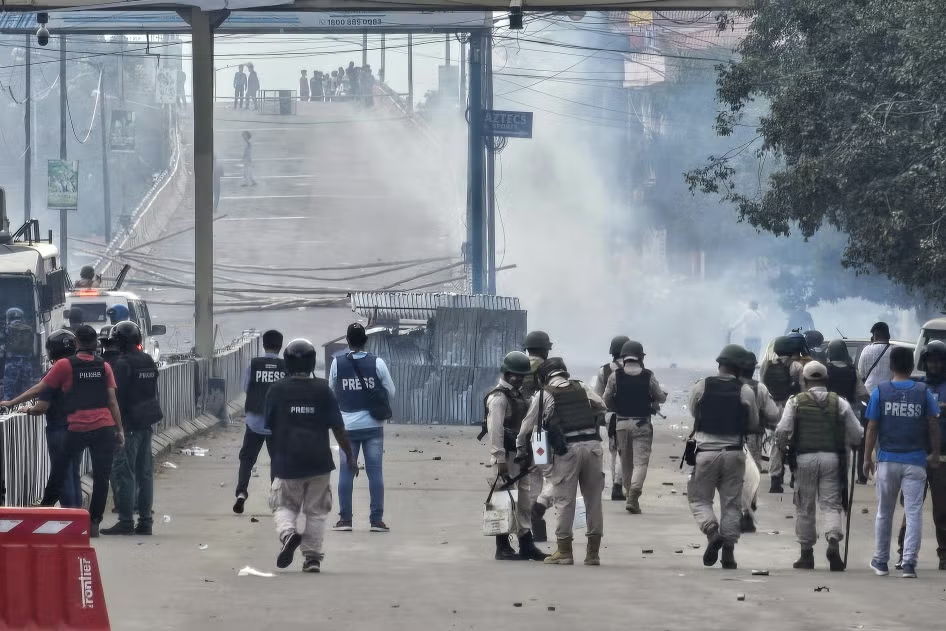
Three years after the onset of ethnic violence in Manipur, over 24,000 displaced people continue to live in relief camps in the face of renewed apprehensions over safety and quality of life as a new wave of attacks and protests erupted following the death of villagers, while the Supreme Court asks for an explanation from the state.
Around 7 am on the 19th of October, 3 villagers collecting firewood were attacked by an armed group near the border of Imphal East and Kangpokpi.
Later that afternoon, 2 bodies were put outside the Chief Minister’s residence in Imphal by angry locals.
Tear gas was used by security forces, and roads were blocked throughout the Valley of Imphal.
The Supreme Court are seeking answers to the unnatural deaths of the displaced, while recent violence demonstrates how far the state has to go to provide true safety in camps.
This incident has occurred just over a month after another reckoning in a New Delhi court.
It raises the key issue of whether the relief camps are providing a safe space for the displaced after the third year of Manipur following ethnic violence in 2023.
Living Conditions in Camps
According to government figures, around 60,000 people have been displaced since 2023.
In September 2026, 24,530 people were still in relief camps, with 4,369 in temporary accommodation, according to Home Department data.
The state says 105 camps are still active, with over 3 years having passed since the violence began, and most of these people have still not returned home.
This is why the court is concerned, as the camps were meant to be temporary accommodation but have now become a long-term home.
Many of these are in schools, community halls or temporary buildings has caused issues over the years.
There is little privacy, shared toilets, variable medical care, reliance on rations and uncertain safety for women and children.
If a sexual assault can happen and deaths can go uninvestigated for months, the camps are failing to provide even the most basic safety.
A Ground investigation should look into:
- Health: Are there regular doctors/nurses? How far away is the nearest hospital? Are chronic illnesses being managed?
- Toilets and Water: How many people share a toilet? Is the water safe?
- Food: Are they receiving enough rations? Are they timely? Are they suitable for babies and the elderly?
- Safety: Are they safe? Are there lights? Security? Complaints? Particularly for women?
- Services: Are they able to access schools, documents, jobs and legal aid?
Overall Failure
The killings on the 19 th of October highlight the situation in the camps because many displaced families are suffering from a lack of safety due to fear.
There is ongoing violence along the borders of Meitei- and Kuki-dominated areas.
Every attack reinforces that it isn’t safe to return home, as the people collecting firewood on the 19th were not in the camps, but the same lack of safety affects everyone.
If the state cannot even provide safety to villagers collecting firewood, it will struggle to provide safety, medical aid and justice to tens of thousands of displaced people.
The Supreme Court is asking why 24,530 people are still in the camps after 3 years.
They died in places that were meant to keep them alive, and this tells us a lot about whether we can trust the state to keep them safe.
