

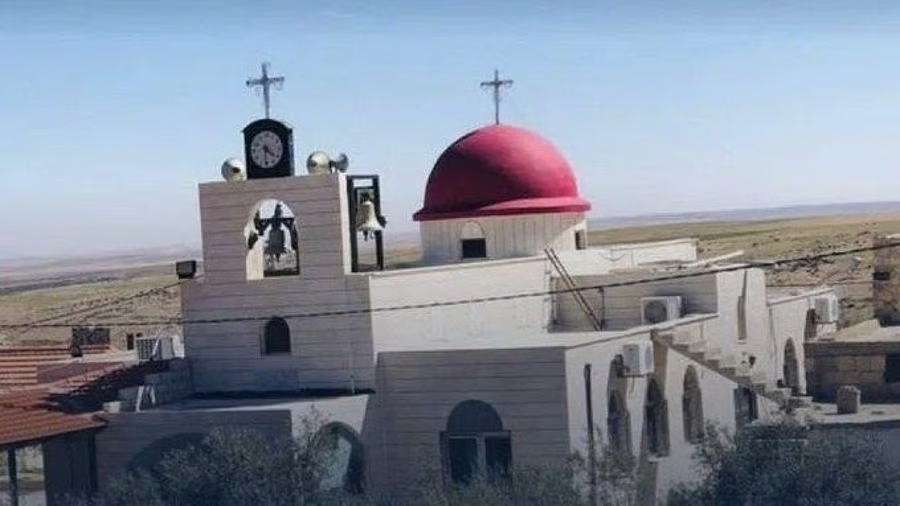
AMMAN: A funeral is where people go to grieve, but on October 23, a Greek Orthodox church in Jordan turned into a shooting scene where nine people died, and dozens were hurt, in Hamoud’s Karak Governorate.
Security forces captured three suspects on October 26 after a few hours of a shootout but the biggest questions remain unanswered.
Why a funeral? Did the attackers choose the gathering on purpose, was the church the target, or was the timing a coincidence?
Surveillance footage verified by ABC News shows at least three gunmen pulling up at the church entrance before they opened fire.
Reuters reported that they kept firing for several minutes in broad daylight.
“A sense of panic took hold among those present,” Priest Theodoros Soueiss told Reuters.
Christians are a minority in Jordan, and St. George’s Greek Orthodox Church in Hamoud is part of the country’s long Christian history.
The shooting has left many Jordanians worried about the safety of worshippers and places of worship.
But the church’s identity alone does not prove religious hatred drove the attack.
King Abdullah II chaired a National Security Council meeting on Saturday and condemned a “despicable terrorist act.” He ordered security forces to respond with an “iron fist.”
Security around malls, foreign embassies, and other areas in Jordan increased following the incident, a statement released by the US Embassy in Amman read.
US also warned stating that it is monitoring the event and advised Americans to be cautious.
Jordan being an ally of the United States in the region on issues of security and counterterrorism explains the importance of the country.
Jordan is an important partner of the US in the war against militant groups.
Pope Leo XIV of the Vatican made a statement after his Angelus prayer on Sunday.
Pope prayed for the injured and those who lost their lives in a terrorist attack on worshippers at St. George’s in Hamoud, Vatican News reports.
He also showed solidarity with the people of Jordan, which is noted for “peaceful coexistence and respect between different religions,” the report added.
The Vatican’s envoy in Amman, Archbishop Giovanni Pietro Dal Toso, visited the injured and their families in several hospitals the day after the attack to convey the Pope’s closeness and condolences.
Jordanian officials called the attack the product of a terrorist ideology.
Prime Minister Jafar Hassan said it resulted from “blind extremism.”
Authorities later said the three suspects were members of one family who lived near Hamoud and acted without prior planning.
No group claimed responsibility, and officials said it was too early to tell whether the attackers had links to known groups.
The investigation needs to find out the motives for each suspect and see if there was any conspiracy behind this shooting.
Without doing all this, it will not be prudent to say that this shooting was aimed at Jordanian Christians.
Further investigation is still ongoing, and this is the only way to analyse this story within the bounds of the information available.
