

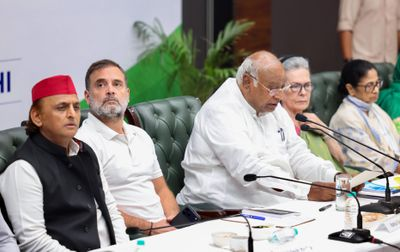
More than 20 opposition parties walked into the Constitution Club in New Delhi on Wednesday for a meeting that, on the surface, was about one man. By the time it wrapped up, it had become clear the INDIA bloc was arguing about something much bigger: whether India’s election machinery can still be trusted to run clean?
The trigger was a report in The Indian Express that Election Commissioners Sukhbir Singh Sandhu and Vivek Joshi had repeatedly disagreed with Chief Election Commissioner Gyanesh Kumar over how the Special Intensive Revision (SIR) of electoral rolls was being carried out, particularly around adding new names to the list.
Congress leader Rahul Gandhi accused Kumar of helping the BJP “steal votes.” That single line turned a bureaucratic disagreement between three commissioners into a full-blown political flashpoint.
Congress president Mallikarjun Kharge used Wednesday’s meeting to lay out a six-point charter of demands:
- Employ pre-SIR electoral rolls with full transparency on additions, deletions, and corrections.
- Prior notice for voter deletion, with reasons and proper appeal system.
- Prevent eligible voters from being disenfranchised due to administrative blunders, insufficient documentation, or lack of knowledge.
- Go back to paper ballot voting, rather than voting through EVMs.
- Make voter registration process easier for young citizens, especially first time voters.
- Institutional accountability and a trustworthy Election Commission are needed.
The opposition thinks thst real problem does not lie in any single decision, but in the process itself.
“As you could also guess, it is the continuation of Gyanesh Kumar, who has tampered with the process of working of the Election Commission,” M.A Baby, CPI (M) MP said.
How can Kumar be immediately removed from the position of the CEC, and how the agitation under the banner of the INDIA Bloc can be taken forward, Baby said, adding that individual parties would still be free to run their own campaigns alongside the joint one.
Bihar’s Leader of Opposition Tejashwi Yadav said, “to protect the Election Commissioner, to protect Gyanesh Kumar, the laws were changed beforehand,” describing as a pattern of large-scale irregularities in how elections have been run.
Not every voice in the room agreed on where the line should be drawn. DMK’s Tiruchi Siva confirmed “In Parliament, we will support whoever brings a removal motion against Gyanesh Kumar.”
National Conference MLA Nazir Ahmad Gurezi kept his framing narrower and more procedural, saying that “the INDIA Bloc meeting is about the SIR,” a reflection of how different parties are approaching the same controversy from different angles.
At a September 26 meeting, the three commissioners, Kumar, Sandhu and Joshi, said in a joint statement that the original order launching the nationwide SIR exercise on June 24, 2025, was approved unanimously by the full commission, not pushed through by Kumar alone.
If the SIR order genuinely had unanimous backing at the time, the Opposition’s case rests on what happened afterwards during the implementation, not the decision to begin.
Under Article 325(5) of the Constitution, an Election Commissioner can only be removed on the recommendation of the CEC, a provision that makes any removal motion against Kumar himself a genuinely uphill legal fight, and the Opposition knows it.
The INDIA bloc is pursuing it anyway, alongside a parallel push for procedural reform through Kharge’s six demands, suggests the actual goal may be less about ousting one official and more about forcing structural change to how voter rolls get revised, verified and audited going forward.
Whether that push succeeds will depend on how far the Opposition can sustain pressure through a united front that, as Wednesday’s meeting showed it still has visible cracks in it.
But the scale of the mobilisation, more than 20 parties, a public charter of demands, and leaders willing to go on record with direct allegations, signals that this is no longer a story about three commissioners disagreeing behind closed doors.
It has become a test of how much faith India’s political class, and by extension its voters, still place in the referee of its elections.
