

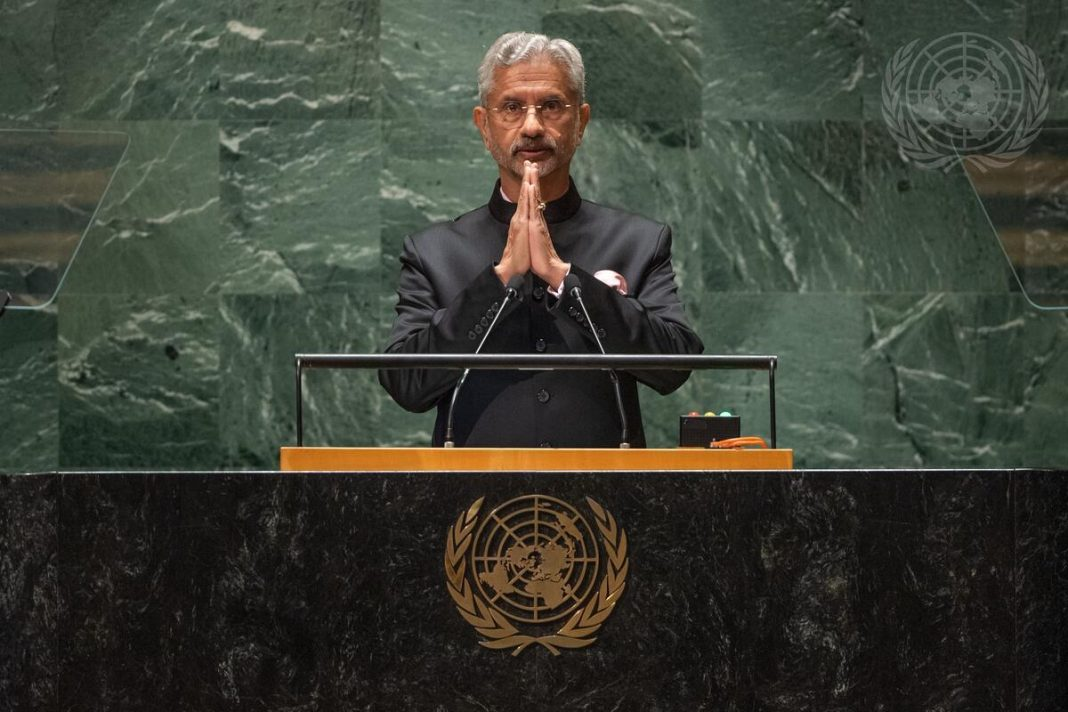
Every autumn for nearly thirty years, India has arrived at the United Nations General Assembly with the same unfinished business: a permanent seat at the Security Council. This year, at the 81st session, held under the theme “Restoring Trust, Managing Transformation,” New Delhi’s delegation was noticeably sharper.
External Affairs Minister S Jaishankar told delegates that “the frustrations are mounting” over the pace of reform and suggested that changes be decided through open discussion and majority vote rather than waiting for every member to agree, reports say.
Adding further, at the inaugural Partners for Multilateralism summit on the sidelines of the Assembly, he set the tone by warning that “we meet at a time when the global order is under stress.”
The Demand
India’s position has not shifted much in substance, only in urgency.
Working through the G4 bloc with Brazil, Germany and Japan, India wants the Council’s size raised from 15 to 25 or 26 members, with six new permanent seats, two in Africa, two in Asia Pacific, and one each in Latin America and Western Europe.
On the thorniest question, veto power, India has refused to accept a watered-down version of membership.
According to Business Standard, New Delhi has argued there cannot be a situation where some permanent members hold veto rights while others do not, backing an “all or none” approach.
The Argument
India’s diplomats argue the Council, created in 1945, no longer reflects the world it is meant to police.
Deputy Permanent Representative Yojna Patel told negotiators that the Council has failed to meet its core responsibilities on peace and security.
“A proposed third category of membership is a red herring meant to derail reform,” he added.
Who Is Backing India
The list of backers keeps growing, which is precisely India’s frustration with how little that support has translated into movement.
Russia’s Sergey Lavrov has cited the shifting global balance since the UN’s founding as reason enough to support India’s bid alongside Brazil’s.
Four Central European nations, Hungary, Poland, Slovakia and the Czech Republic, extended fresh backing at a first-of-its-kind V4 India foreign ministers’ meeting in New York this week.
Why Nothing Moves
The obstacle has never been a shortage of endorsements; the five existing permanent members have not agreed on a single model for expanding the Council.
They differ over how many seats to add, how to distribute them regionally, and whether new permanent members should have the same veto powers as the current P5.
Jaishankar pointed to the lack of a formal negotiating text as the central problem, arguing that reform talks have stalled because there is nothing concrete on paper to negotiate.
What Comes Next
Beyond the podium, Jaishankar used the sidelines of UNGA to keep the issue alive in one-on-one meetings, including with French Foreign Minister Jean-Noël Barrot, where Security Council reform was discussed alongside Ukraine and Gulf tensions.
India is also pursuing a non-permanent Council seat for the 2028-29 term, with elections due next June, a smaller but nearer-term goal even as the larger campaign for a permanent chair continues.
