

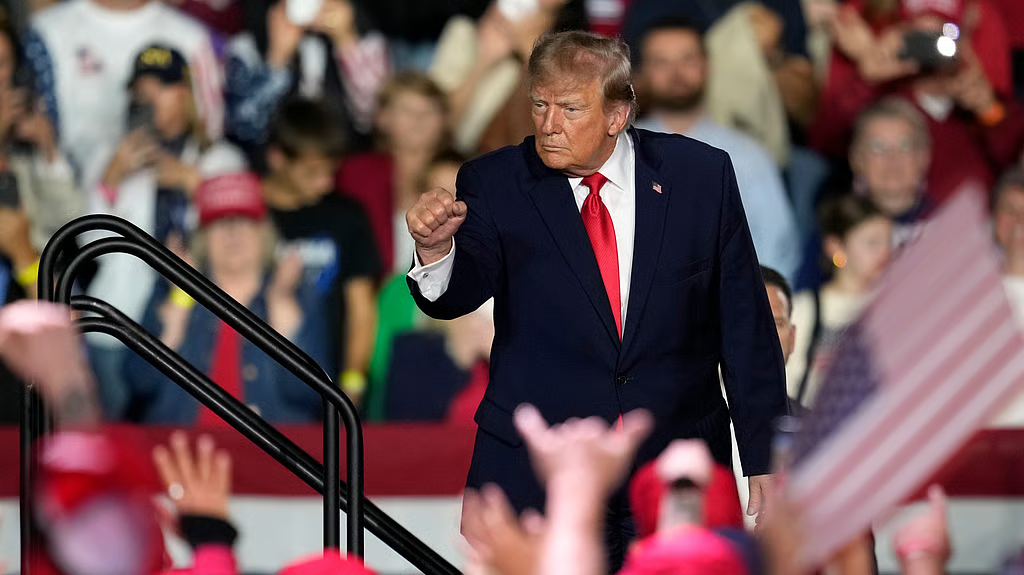
Democrats took over both Houses of Congress on November 5 in the midterm elections, giving President Donald Trump’s Republicans reason to worry, as poll projections had indicated, for the first time in 20 years, opposition controls both Houses of Congress under a Republican president.
In the House of Representatives, Democrats won more than 218 seats to claim a majority and took power from Republicans who controlled the House.
This leaves Democrats better positioned to investigate the Trump administration, examine various government agencies and also oppose any Republican bills.
The Democratic Party also took control of the Senate by winning more than 54 of the 100 Senate seats on November 4.
With the majority, Democrats now control procedures of the Senate, including committee chairs, confirmations of nominations and votes on presidential nominees.
The Senate elections shocked even more as Democrats flipped seven seats previously by Republicans, namely in Michigan, Maine, Iowa, Kansas, Ohio, North Carolina and Texas.
Moreover, they won another seat in South Carolina, but Republicans started election day with a 53- 47 lead, and these are the states where Trump won last time.
Democrats advanced in Texas, Ohio, Michigan, Maine and Iowa, which were traditionally loyal to Republicans.
These results will play an important role in shaping the final two years of Donald Trump’s second-term presidency.
But having a say in Congress does not necessarily mean Democrats will overturn presidential choices, while the presidential veto will still be operational.
Records and firsts after the United States Midterm election
- Abdul El-Sayed set a historic record by becoming the first Muslim elected to the United States Senate.
- Adam Hamilton won in Kansas, the first Democratic Senate victory there since 1932.
- James Talarico became the first Texas Democrat elected to the Senate since 1988. His race was the most expensive Senate contest in US history.
- Democrats won a South Carolina seat they lost when Strom Thurmond switched parties in the 1960s.
- In Maine, Troy Jackson ousted Susan Collins after 30 years.
- Chris Pappas of New Hampshire became the first openly gay man elected to the Senate.
- Georgia’s Keisha Lance Bottoms will become the first Black woman governor in US history.
Why voters turned?
Democrats had a lead in national congressional preference polls, and November 3 put them up 8.4 percentage points.
“Democratic House majority was almost certain and that they had moved into a strong position to capture the Senate,” Election analyst Nate Silver’s Silver Bulletin said.
NBC News polls put them seven points ahead of Republicans in their November 1 report.
A couple-of-percentage-point lead can still change outcomes because of errors or turnout, but the margins were wide enough this time.
Trump’s approval rating hit 38 per cent, historically low for a president in the midterms, and 89 per cent of voters cited the cost of living as a crucial factor.
Millions of American voters weighed the Trump administration’s management of the country, including war-driven fuel prices, tariff-driven price increases, the cost of living and immigration.
Vice President JD Vance blamed the Iran war for the GOP losses.
Florida Governor Ron DeSantis called the results close to an extinction-level event for Republicans.
Historically, the sitting president generally gets ground out in midterm elections. “They say that when you win the presidency, you lose the midterm,” Trump said.
I mean, they will find a reason to impeach me. I will get impeached, he added.
Trump didn’t plan the campaign, but he visited three states he won in 2024 in a last-minute scramble to fix his low approval ratings.
The economy drives that rating, with expenses mounting on fuel, healthcare and groceries.
The rest of Trump’s tenure now faces investigations into his administration and business dealings, which could lead to another impeachment.
California Rep. Robert Garcia is set to lead the House Oversight Committee.
I want to dig into the administration’s immigration and detention policies with demands for accountability for ICE’s tactics, Garcia added.
Trump’s laws can now get blocked, his budgets delayed and his appointments stopped.
With full control of the Senate, Democrats can block Trump’s nominees, and several have cast doubt on confirming any Supreme Court pick.
Democrats also plan to challenge the tariffs they call “illegal” and a “misuse of power,” arguing that Congress, not the president, holds the authority to impose tariffs.
If they challenge the tariffs, the effect will extend beyond the US, because a legislative or legal restriction would hit US trade and global supply chains.
Not just with tariffs, but if these checks and balances restrict Trump’s power, global energy markets can normalize.
The opposition in Congress requires Trump to put focus back on domestic affairs, such as budget approval, despite the challenging opposition.
That directly leads to lower chances of the President waging wars and invading countries.
The new Congress will be sworn in January 2027.
