

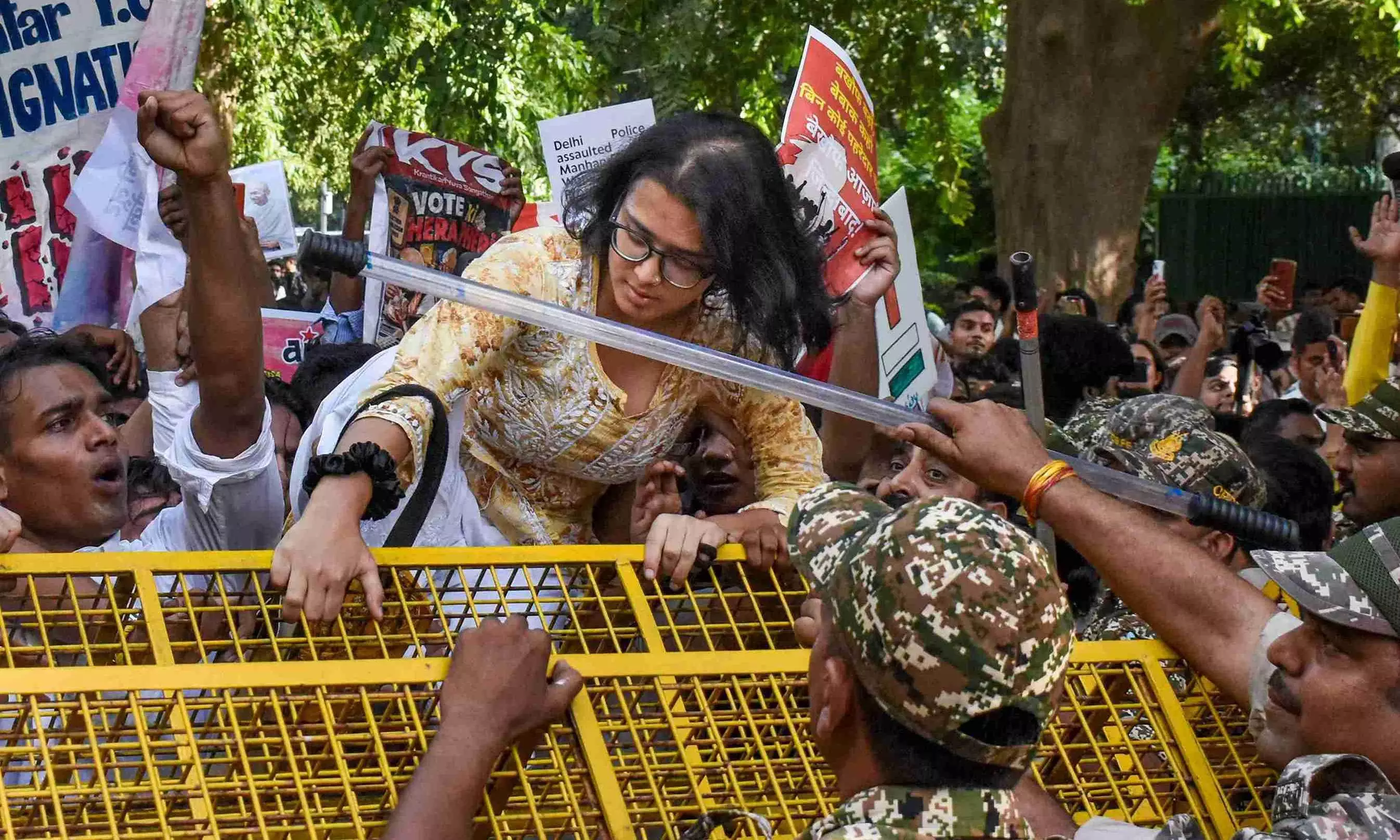
Delhi has seen this week how quickly a protest against Chief Election Commissioner Gyanesh Kumar can turn tense. On Saturday, October 10, two separate calls to march on Jantar Mantar will test how the capital handles dissent.
First, the Cockroach Janta Party’s (CJP) founder Abhijeet Dipke announced the Delhi march after thousands gathered at Mumbai’s Shivaji Park on October 2, despite police refusing permission.
“If Kumar does not step down, supporters from across the country will converge on the capital,” Dipke said.
He has promised a peaceful agitation and warned of “Jantar Mantar 2.0,” adding that “wherever police stop us will become our Jantar Mantar.”
The second call comes from the Left. On Tuesday, five student organisations (AISA, SFI, AISF, PSU and AISB) issued a joint statement urging the public to join their march.
With the blunt statement, “Gyanesh Kumar, your days are numbered,” student organisations demand Kumar’s resignation, withdrawal of the Special Intensive Revision of electoral rolls, and reforms in the Election Commission.
The two different calls share a demand and a venue, but they come from different organisations.
No confirmation from CJP and the Left to merge their plans, but Saturday could escalate tensions in the national capital.
A tense run-up
Delhi police on October 4 signalled how they intend to respond; at least 5,000 personnel were deployed, and 700 people were detained on their march to Jantar Mantar.
“The site has limited capacity, and organisers should apply for Ramlila Maidan instead,” an officer said.
CJP spokesperson Saurav Das has claimed the government intends to arrest him and Dipke before October 10.
The movement is no longer only a student affair as INDIA bloc MPs marched towards the ECI on Tuesday and were halted near the NITI Aayog office, where they sat down on the road.
This includes Priyanka Gandhi Vadra, Abhishek Banerjee and Akhilesh Yadav were among them. Shiv Sena (UBT) MP Sanjay Raut questioned the heavy security deployment against unarmed lawmakers.
Four things will show how the day unfolds: first, whether police allow any gathering at Jantar Mantar or steer protesters to Ramlila Maidan.
Second, will the CJP and Left contingents march together or stay apart and third, whether opposition parties add their numbers.
The last is whether the day ends in a large number of detentions or passes without incident.
For the protesters, the stakes are visibility and momentum. For Delhi Police, the test is whether crowds from two movements can be managed without intensifying the situation on Sunday.
