

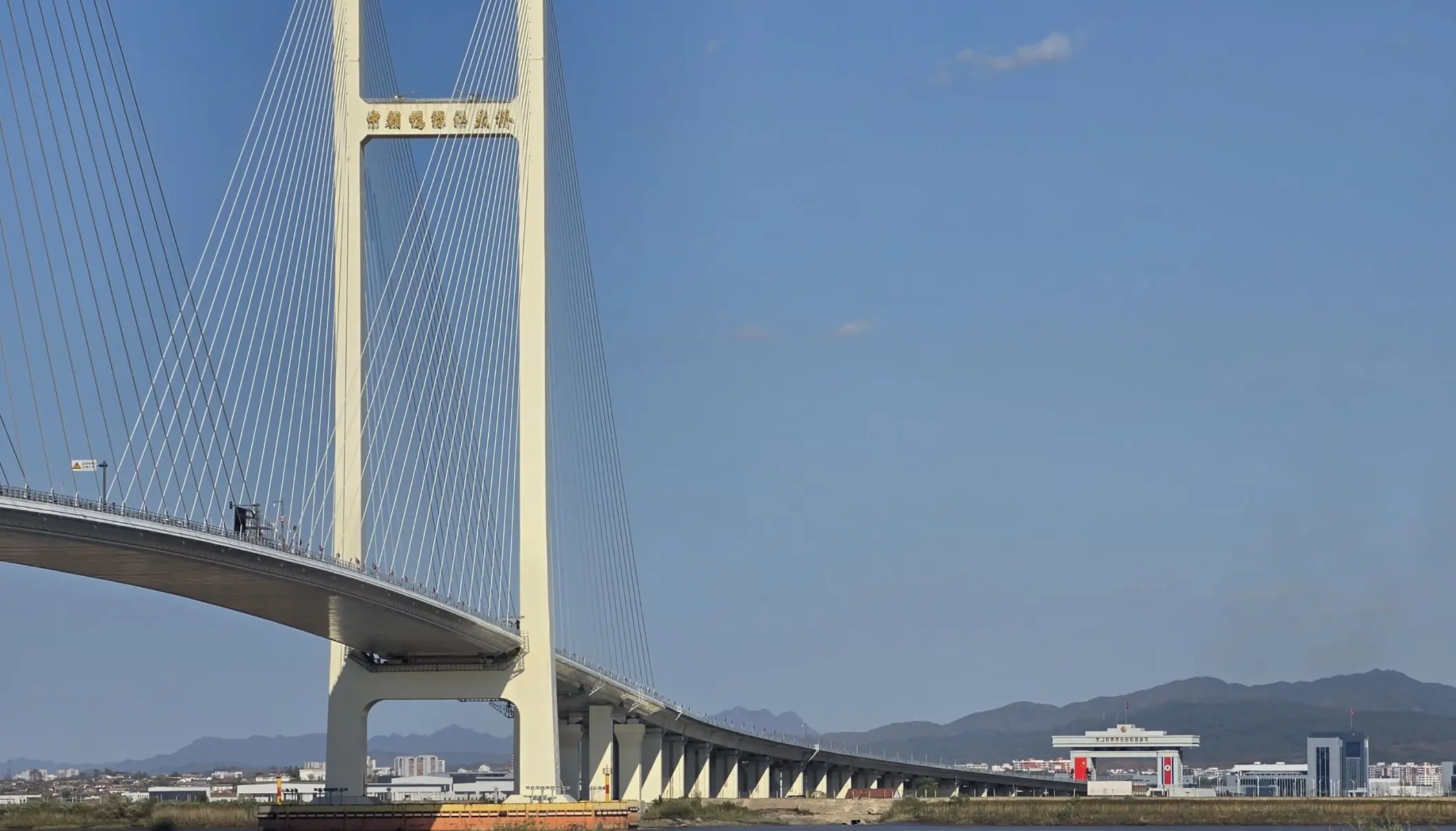
A bridge that sat unused for more than a decade is about to link China and North Korea, and it is drawing fresh attention to how tightly Pyongyang’s economy is tied to Beijing.
China finished the dual-carriageway New Yalu River Bridge in 2014 to connect free trade zones in Dandong with the North Korean city of Sinuiju.
The opening was postponed indefinitely because the road ended in a field outside Sinuiju.
In September, Reuters reported that a South Korean analytics firm, SI Analytics, believed North Korea was finishing its section for an imminent opening.
According to Reuters, work resumed after Chinese President Xi Jinping visited North Korea in June, and the two sides have restarted passenger trains and direct flights between their capitals.
SI Analytics noted that North Korea and Russia opened their first road bridge days earlier, giving Pyongyang new land links on both its eastern and western flanks.
In Dandong, residents are waiting to see the changes as dozens gathered near the bridge in October.
“They finally finished their side,” Taxi driver Wang told Reuters. The same report said that the city once thrived as North Korea’s main trade gateway, but its new zone remains largely residential with many vacant apartments.
According to Statista’s analysis of UN Comtrade data, China exported 99 per cent of goods to North Korea in 2022 compared to 85 per cent in 2015.
At the same time, 70 per cent of imports were from North Korea. According to statistics from Chinese customs, bilateral trade totalled USD 229 million in June, illustrating the improvement.
UN sanctions are still considered a primary limitation for China, as per a 2018 report by The Associated Press, which says China’s imports from North Korea decreased by 92.6 per cent because of sanctions.
Adding that China had prohibited importing textiles, seafood and coal from North Korea.
Around USD 38,000 worth of shipments of cars, which are likely to violate the sanctions, and also outsourcing textile production took place, sources say.
In 2017, Chen Xiaohe, an international relations expert at People’s University, noted that the complete isolation of North Korea through the complete restriction of trade would result in famine.
Construction of such a bridge will make it easier for Pyongyang to have access to Chinese products, while at the same time making it difficult to track whatever comes through the border.
The construction of the bridge is just part of a bigger trend of North Korea establishing itself in China as well as Russia.
