

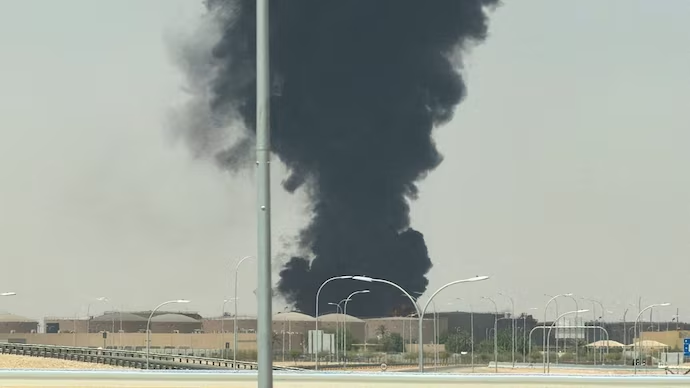
Saudi Arabia issued emergency air raid alerts in the early hours of Saturday, following warnings late Friday of a potential security threat, reports say.
The alerts were issued around 3 am and covered several areas, including nearby cities and parts of the Red Sea coast. It was the first such air raid warning since the conflict escalated.
According to sources, Explosions were heard, and smoke was visible from King Khalid International Airport in Riyadh on Saturday.
The Houthis said that the Saudi Air Force has conducted several airstrikes against them in recent days.
Backdrop to the escalating conflict
The attack comes after Riyadh accused the rebels of targeting the Holy City of Mecca. Saudi air defences destroyed the drone before it could enter the city’s protected airspace.
Riyadh’s coalition spokesman Turki al-Malki called the security of the holy site and its pilgrims a “red line,” warning that the kingdom would take harsh measures if required.
The Houthis denied the accusation, saying that retaliatory strikes were carried out by Riyadh every day.
The accusation triggered responses in support of Saudi Arabia and condemnation across the Muslim countries.
Increasing pressure on Saudi Arabia
The ongoing events are putting pressure on Riyadh, even though it is not a direct participant in the broader US-Iran war.
The Houthi control over the Bab el-Mandeb strait, combined with the shutdown of Saudi’s East-West oil pipeline, has had global impacts on oil prices.
According to the ISW and CTP, Saudi Civil Defence issued more early-warning attack alerts in a single 24-hour period between September 14 and 15, since the start of the Houthi blockade in late July 2026.
Saudi Arabia’s joint defence pact signed with Pakistan and Turkey is designed to treat an attack on one signatory as an attack on all.
Officials from Pakistan and Turkey confirmed that they have not received a formal request for support under the pact.
Saudi Crown Prince Mohammed bin Salman’s request for direct US military intervention has been declined, with Washington refusing to deploy its forces while offering intelligence-sharing support.
The International stance
The UN Security Council stated on Friday, “condemned in the strongest terms continued Houthi attacks against the Kingdom of Saudi Arabia, including attacks impacting civilian and energy infrastructure, which have resulted in the injury of women and children.”
The Organisation of Islamic Cooperation (OIC) condemned the attacks by saying that these attacks instil fear in innocent civilians, violate the sanctity of holy sites and mosques, and provoke the sentiments of Muslims around the world.
How would Riyadh respond?
Riyadh’s immediate priority will be restoring a sense of security and protecting its most vital sites.
Saudi Arabia is launching retaliatory strikes on Houthi positions in Yemen; it is likely to prompt further statements of support and appeals for backing from Gulf allies and the OIC.
Regardless of whether the Mecca allegation is proved or confirmed, both sides continue to use it for strategic purposes.
Houthis use it to flatly deny accusations with statements such as “a worn-out lie”.
Saudi Arabia uses the allegation to get the support of the coalition and other Muslim countries.
