

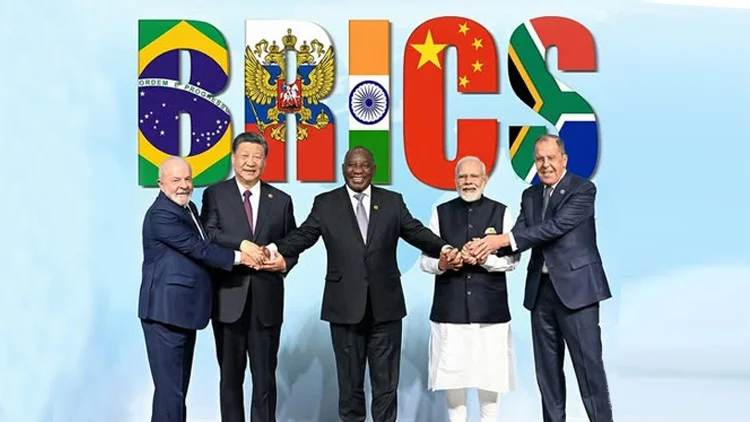
A two-decade milestone since its founding, leaders from eleven nations gathered in New Delhi for the 18th BRICS Summit.
What began in 2006 as an informal club of four large emerging economies has become something far bigger and more complicated.
In 2001, economist Jim O’Neill proposed a plan that names Brazil, Russia, India, and China as the emerging markets that will shape the world economy.
This resulted in the creation of an official diplomatic platform in 2009, with South Africa joining in 2011.
For more than ten years, the bloc has consisted of five countries. In January 2024, Egypt, Ethiopia, Iran, Saudi Arabia, and the United Arab Emirates officially joined the group, with Indonesia added in 2025.
The bloc now includes eleven countries with a combined population of over 50 per cent of the world’s population and accounts for approximately 40 per cent of global GDP.
At the New Delhi summit, the leaders adopted a joint declaration based on several common themes.
A louder voice for the Global South. The bloc reaffirmed its commitment to bolstering multilateralism and its vision of a multipolar world order, which it believes will enable emerging and developing countries to adopt a more inclusive and equitable approach to the international economy.
This has been the central tenet of BRICS since its inception: that the institutions created in the aftermath of World War II, primarily the IMF, World Bank, and WTO, no longer reflect the economic realities of the developing world and should be reformed.
Reducing dependency on the US dollar, focusing on national currencies in foreign trade and creating new cross-border payment tools were discussed at the BRICS summit.
The concept of de-dollarisation did not explicitly feature in the New Delhi Declaration, but analysts see it as a practical way to reduce dependence on the dollar through the use of local-currency payments.
At the same time, the concept of a single BRICS currency is not progressing. The Indian Ministry of External Affairs stated that “there is no proposal for a BRICS currency” after the New Delhi summit turned to the idea of strengthening the local-currency payment system.
Broadening the economic focus, the group has pursued deeper cooperation in areas such as technology, energy, health, infrastructure, and sustainable development.
India’s chairmanship this year prioritises innovation and resilience, including a ministerial-level meeting of space agencies of all 11 BRICS countries in June.
BRICS is not to recreate alliances or trade blocs with their own regularities and frameworks. Rather, it wants to act as a coordinating hub for building parallel institutions.
A development bank, settlement system, and technology partnerships that would reduce the West’s geopolitical and economic leverage over the rest without confronting it.
A five-power club with similar goals could conceal internal differences behind a united front; an 11-power group encompassing Tehran, Abu Dhabi, Moscow, and New Delhi is unlikely to do the same.
The BRICS heads of state at the New Delhi summit suggest that the bloc can formulate a common position on trade, geopolitical issues, and institutional reforms.
But as the attendees’ own statements acknowledged, the bigger challenge may be for the enlarged BRICS to translate its ambitions into a coherent strategy.
