

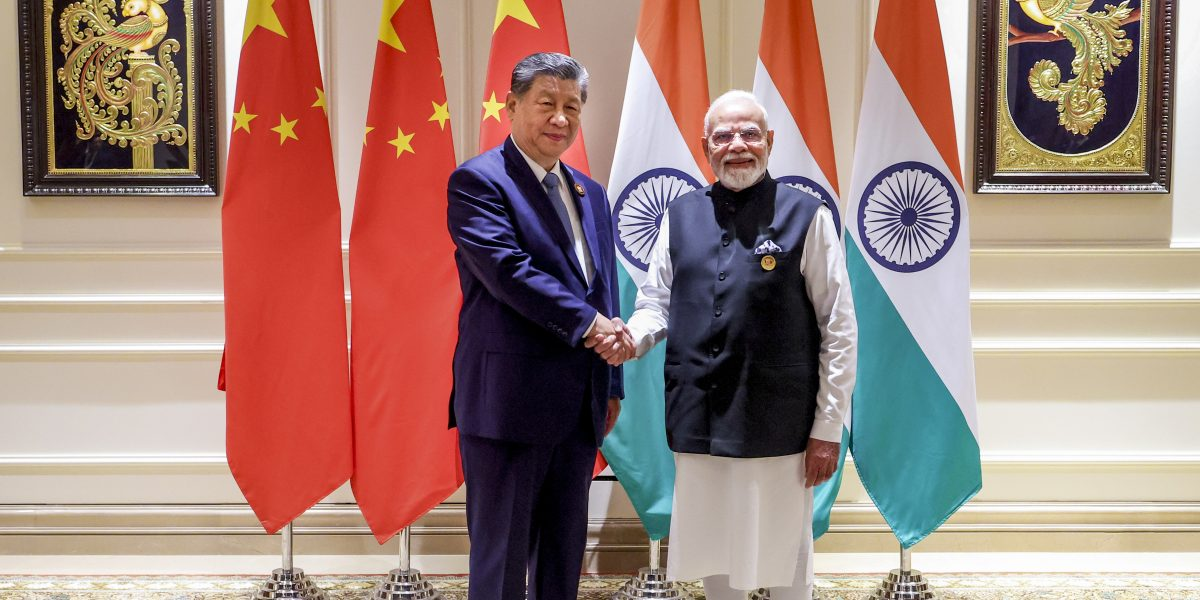
Chinese President Xi Jinping made his first visit to India in seven years for the 18th BRICS Summit on September 12 and 13 in New Delhi, marking his first trip to the country since the 2019 informal summit with PM Modi and the deadly 2020 Galwan Valley border clash that plunged bilateral ties to their lowest point in decades.
The bilateral meeting between China and India was the most awaited this week because it reveals India’s diplomatic strategy with major powers.
When trade tensions with the United States put pressure on New Delhi, closer ties with Beijing give more economic and diplomatic options.
The bilateral talks are important as a voice of the Global South through BRICS. Both countries are two of its important economies.
Conflict between them portrays a weak image for a bloc that is challenging Western-led institutions, with improved relations leading to better cooperation in BRICS.
Last month, Wang and Doval issued a joint statement including an eight-point consensus for peace on the border. The talks test whether the improvement in relations can continue as unresolved border issues persist.
China became India’s largest trading partner in FY 2025-26, reaching USD 151.1 billion, but New Delhi’s trade deficit with Beijing has more than doubled between FY 2020-21 and FY 2025-26, posing a trade imbalance disadvantage.
As per the bilateral meeting, Modi and Xi discussed the trade imbalance, supply chain issues, and market access.
PM Narendra Modi said that “peace and tranquillity” in the border areas is essential for developing bilateral relations with Beijing.
Both countries met in October 2024 at the BRICS Summit in Russia and in Tianjin last year at the SCO summit, which made the bilateral talks more welcoming and improved the extremely strained relations.
The Galwa Valley clash of 2020 resulted in India banning Chinese apps and tightening FDI policies, with other restrictions.
Two countries deployed thousands of troops and equipment into Eastern Ladakh, with lingering distrust from each camp, making it a costly and prolonged confrontation.
“China and India are partners rather than rivals, and present opportunities for each other’s development rather than threats”, Xi Jinping said, according to Xinhua, a Chinese state media.
National Security Adviser Ajit Doval, Foreign Secretary Vikram Misri and India’s ambassador to China, Vikram Doraiswami represented India with Modi.
Xi Jinping, Cai Qi, close aide to Xi, and Foreign Minister Wang Yi represented China, as per reports in the South China Morning Post.
The ongoing engagement stems from different priorities for both countries.
India seeks economic opportunities in a growing relationship with China. It needs the trade deficits and dependence on imports to be addressed.
Whereas Beijing seeks a stronger multipolar world system which strengthen the Global South against Western influence.
According to The Hindu, China has supported India’s aspiration to play a greater role in the UN, as part of its broader push.
