

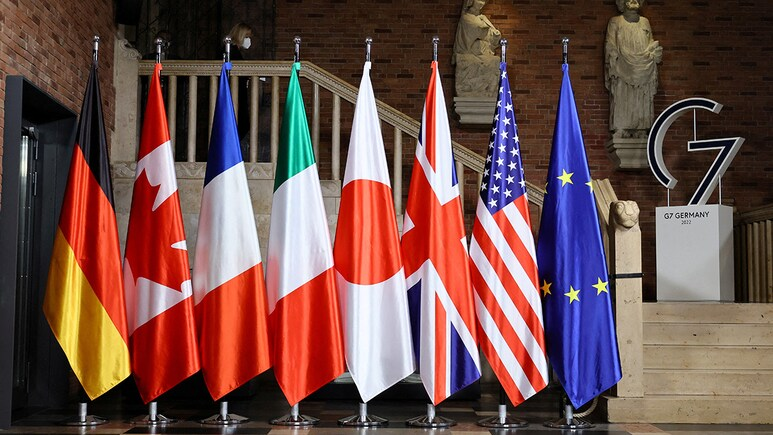
G7 foreign ministers began two days of talks in Paris on Monday, with European counterparts set to press US Secretary of State Marco Rubio to pursue a settlement fair to Kyiv and avoid new escalation with Iran.
The talks coincide with US-mediated negotiations with Moscow and Kyiv in Abu Dhabi on Tuesday and Wednesday.
The question hanging over the meeting is whether the allies can still speak with one voice.
European officials fear Kyiv could be pressured into disadvantageous terms and that Washington might offer Russia security guarantees without European involvement.
Those fears were stoked when President Donald Trump predicted a “very big” deal with Russia covering all of Europe.
“There can be no solution without Europe, only with Europe,” Foreign Minister Johann Wadephul said.
He also said the Abu Dhabi talks must show whether Russia is “genuinely prepared to negotiate” and warned against a staged process.
Rubio, for his part, said postwar security guarantees remain a key US concern and that nothing has been finalised.
Paris’ Jean-Noël Barrot said officials from France, Britain, Germany, NATO and the European Commission will be in Abu Dhabi.
“We certainly cannot afford any military escalation at this point,” Federal Minister for Foreign Affairs of Germany Johann Wadephul said on Iran.
At the group’s March meeting, most of America’s closest allies had greeted the Iran war with deep scepticism, with host France highly sceptical.
Energy has been part of the dispute, as reporting in March noted that the Strait of Hormuz had effectively been closed, choking about a fifth of global oil supplies.
Japan’s foreign ministry said then that a stable energy supply and stable crude prices were extremely important.
Underneath both files is unease about Washington’s direction as Rubio is making his first overseas trip since the midterm elections.
Four G7 diplomats said ministers want to gauge whether Trump’s midterm defeat changes US policy toward Ukraine, the Middle East and allies.
US pressure on the International Criminal Court, and disputes over Ukraine and NATO, remain further sources of friction.
“The G7 countries share an interest in protecting advanced AI models from extraction and misuse,” Rubio said.
Marseille will still host the launch of a network of 14 global ports to combat drug trafficking, Barrot said.
On Russia, Canada announced new sanctions on the sidelines of the meeting, a reminder that members can act nationally even when group positions diverge.
The outlook is a thin common front rather than a unified one, as Europeans are likely to coordinate around demands.
Ukraine and Europe have a seat at any settlement, and talks with Iran take priority over force. Whether Washington accepts those terms may be clearer after Abu Dhabi.
The United States takes over the G7 presidency from France in 2027, which raises the question of a shared diplomatic line.
