

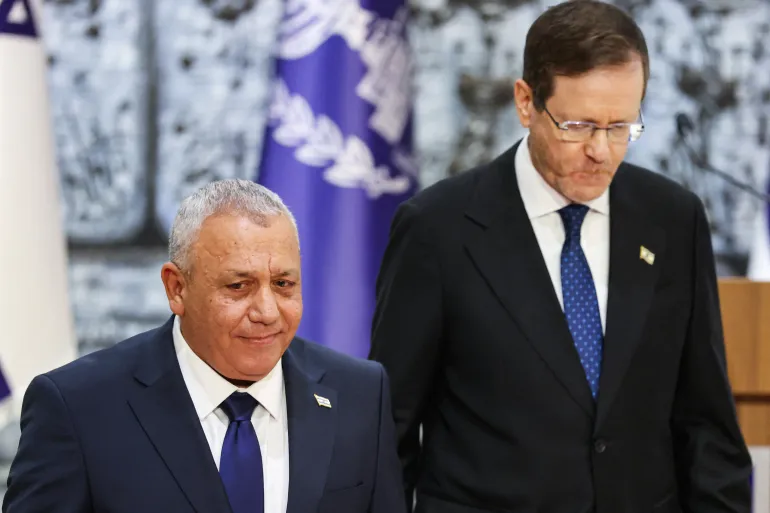
Israeli President Isaac Herzog made the awaited decision, and an official presidential mandate ceremony was held on Saturday, during which Eisenkot was told to form a government within 28 days.
The opposition leader has yet to decide whether to enter a power-sharing arrangement with Netanyahu, reach an agreement with ultra-Orthodox parties that would require military exemptions, or seek support from Arab-led parties, a move his own bloc has discouraged.
During the swearing-in ceremony, Herzog told lawmakers, “You must do everything to avoid a repeat election.”
A repeat election might happen if both Eisenkot and Netanyahu fail to form coalitions. Until then, Netanyahu remains caretaker prime minister.
In Israel’s October 27 elections, Eisenkot’s four-party opposition bloc won 48 seats, while Netanyahu’s right-wing bloc secured 53, leaving both short of the 61 needed for a parliamentary majority.
Arab-led parties representing Palestinian citizens of Israel won a record-high 19 seats.
The opposition leader has called for a unity government and appealed to the Likud party and far-right Religious Zionist Party to join him – but only with himself as prime minister.
“If members of Likud and the Religious Zionist Party truly believe this is a time for unity, as they told the president, I cannot conceive of any reason why they would not support a government under my leadership and the principles I have presented,” Eisenkot said.
Eisenkot has reached an agreement with four opposition leaders to be in key parliament positions, and the leaders have also named former minister Matan Kahana as their candidate for Speaker of the Knesset.
The next leader must have to deal with challenges immediately as military activities under Netanyahu’s rule have deepened isolation and strained foreign relations.
Domestic polarisation and systemic violence have worsened, but Netanyahu’s response to this was more violence.
Eisenkot has decided to fix Israel from its “descending to dark places, to a point of no return”.
Eisenkot has laid the conditions of recognition of Israel as a Jewish state and declaring the Palestinian militant group Hamas as a terrorist organisation for any Arab party to join his coalition.
Netanyahu criticises the prospect, saying the alliance with Arab parties would be an act of betrayal.
The prime minister had also called for a “national unity” government, but the possibility of a power-sharing agreement is not looking optimistic.
According to The Guardian, “These types of coalition governments are notoriously fragile and often collapse.”
Herzog can provide a two-week extension to Eisenkot if he is not able to form a government within 28 days. If Netanyahu also fails to form a government, fresh elections will be required.
Many of Netanyahu’s critics say that is his aim, but the big question in Israeli politics now is: does the opposition really want to get rid of Netanyahu?
The opposition to Palestinian Israelis in mainstream politics is so strong that they’re willing to risk keeping Netanyahu in power by going back to the ballot box,” said Al Jazeera’s Nour Odeh, reporting from the occupied West Bank.
The country has held five elections between 2019 and 2022 because of prolonged coalition deadlocks.
